
China’s Oncology Paradigm Shift: From Proof-of-Concept to FDA Registration Pathway —
EXECUTIVE SUMMARY
ASCO 2026 provides definitive evidence that China has completed its transition from a proof-of-concept and enrollment-speed geography to a validated FDA registration pathway for oncology therapeutics.
- The ivonescimab HARMONi-6 plenary presentation delivering a 34% reduction in death risk (HR=0.66; median OS 27.9 vs. 23.7 months; two-year survival 64.7% vs. 48.6%) with simultaneous Lancet publication and FDA BLA acceptance.
- Represents the first China-originated study to achieve both ASCO plenary status and U.S. regulatory submission acceptance. This milestone, occurring just four years after sintilimab’s 14-1 ODAC rejection,
- Establishes a replicable framework: first-in-class mechanisms addressing genuine unmet need, proactive FDA engagement, and multiregional design where appropriate.
The paradigm shift extends well beyond a single molecule. At ASCO 2026, izalontamab brengitecan demonstrated OS hazard ratios of 0.60 in TNBC and 0.64 in esophageal SCC, sacituzumab tirumotecan achieved an OS HR of 0.55 in first-line NSCLC, and IBI363 reported an 86.4% ORR in early proof-of-concept, magnitudes of benefit comparable to daraxonrasib’s practice-changing HR of 0.40 in pancreatic cancer.
- These programs are underpinned by licensing partnerships totaling approximately $15 billion in potential value (SystImmune- BMS $8.4B, Akeso→Summit $5B, Kelun-Merck $1.4B+), confirming multinational pharma’s willingness to invest at registration-pathway valuations for China-originated assets.
For CRO strategy, this convergence of regulatory precedent, clinical validation, and commercial deal flow necessitates upgrading China from a phase III to speed-and-PoC must for an an integrated registration pathway offering.
- The Australia+China bundled Phase I/II model, leveraging Australia’s CTN pathway for Western-patient PK/safety data alongside China’s enrollment velocity, positions CROs to serve the full development arc from first-in-human through BLA submission, capturing value at each stage of the China-to-global commercialization journey.
Introduction
The 2026 American Society of Clinical Oncology (ASCO) Annual Meeting marked a watershed moment in global oncology drug development. For the first time, a China-originated, China-conducted Phase III study, the HARMONi-6 trial of ivonescimab — was selected for plenary presentation and simultaneously accepted by the U.S. Food and Drug Administration as the basis for a Biologics License Application. This milestone, combined with an unprecedented wave of China-originated bispecific antibodies and antibody-drug conjugates (ADCs) reporting positive Phase III data at the same meeting, signals a fundamental transformation in China’s role within the global oncology development ecosystem.
Historically, China’s value proposition for multinational clinical development has centered on two pillars: rapid proof-of-concept (PoC) generation and enrollment speed. The regulatory landscape was characterized by the 2022 sintilimab ODAC rejection, where a 14-1 vote concluded that China-only data could not support U.S. approval. Four years later, the ivonescimab BLA acceptance demonstrates that China-originated programs can now achieve FDA registration — provided they meet specific design, mechanistic, and engagement criteria. This evolution, combined with licensing deals totaling approximately $22 billion in potential value across three landmark partnerships , compels a strategic reassessment of China’s position in the global development pathway.
This evidence supports Emerald Clinical’s China Edge from “Growth PoC & Speed” to “Growth PoC, Speed & Registration Pathway,” analyzing clinical data, regulatory precedent, and strategic implications for CRO positioning in the China-to-global development era.
The HARMONi-6 Watershed: Ivonescimab Plenary Data
Trial Design and Patient Population. HARMONi-6 (NCT05840016) was a randomized, Phase III trial enrolling 532 patients with previously untreated stage III–IV squamous non-small cell lung cancer (NSCLC). Patients were randomized 1:1 to receive ivonescimab 20 mg/kg every three weeks or tislelizumab 200 mg every three weeks, each combined with paclitaxel 175 mg/m² and carboplatin AUC 5 for four cycles, followed by maintenance monotherapy. Stratification factors included disease stage (IIIB/IIIC versus IV) and PD-L1 tumor proportion score (≥1% versus <1%).
- Ivonescimab’s bispecific PD-1/VEGF mechanism delivered a 4.2-month median OS improvement (27.9 vs 23.7 months)
- This positions ivonescimab as a potential new first-line standard in squamous NSCLC
- The trial validates the PD-1/VEGF bispecific class as a baseline comparator in NSCLC, directly relevant to your PoC requirements framework where bispecifics “must show incremental benefit vs IO ± VEGF SOC (ORR, PFS/OS)“
- The FDA accepted Summit Therapeutics’ BLA for ivonescimab plus chemotherapy in EGFR-mutated NSCLC post-TKI therapy in January 2026, with a PDUFA target action date of November 14, 2026 . Ivonescimab is currently approved only by China’s National Medical Products Administration (NMPA).
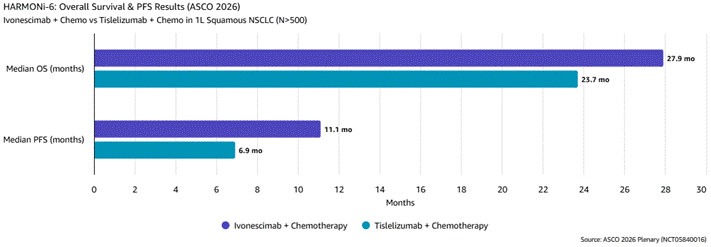
Publication and Regulatory Milestones. The OS results were published simultaneously with the ASCO 2026 plenary presentation in The Lancet (DOI: 10.1016/S0140-6736(26)00966-9) on May 31, 2026, with earlier PFS results having been published in The Lancet in November 2025. Professor Shun Lu of Shanghai Chest Hospital, the principal investigator, presented the data during the Plenary Session.
Implications for Future Submissions. The regulatory pathway ivonescimab acceptance establishes a clear framework for China-originated programs seeking FDA registration: demonstrate first-in-class or best-in-class differentiation, address genuine unmet medical need, incorporate multiregional enrollment where feasible, use OS or validated surrogate endpoints, and maintain proactive FDA engagement throughout development.
China-Originated Bispecifics and ADCs: The ASCO 2026 Portfolio
ASCO 2026 featured an unprecedented concentration of positive Phase III readouts from China-originated bispecific antibodies and ADCs, collectively demonstrating the maturation of China’s oncology innovation ecosystem.
Izalontamab Brengitecan (SystImmune/BMS). This EGFRxHER3 bispecific ADC reported positive Phase III results in two distinct indications. In the PANKU-Breast02 trial (BL-B01D1-307), 418 patients with metastatic triple-negative breast cancer (TNBC) who had progressed after 1–2 prior lines were randomized 1:1 to izalontamab brengitecan versus physician’s choice chemotherapy. Median OS was 15.9 versus 12.5 months (HR 0.60; 95% CI 0.42–0.85; P=0.0019), with a 71% reduction in PFS risk. In the PANKU-Esophagus01 trial (BL-B01D1-305), 497 patients with recurrent or metastatic esophageal squamous cell carcinoma (ESCC) progressed after first-line PD-1/PD-L1 plus platinum were randomized to izalontamab brengitecan 2.5 mg/kg versus chemotherapy. Median PFS was 4.2 versus 2.0 months (HR 0.50; P<0.0001), median OS was 9.8 versus 7.2 months (HR 0.64; P=0.0004), and ORR was 35.3% versus 13.1%. The FDA had previously granted Breakthrough Therapy Designation for izalontamab brengitecan in EGFR-mutated NSCLC in August 2025 .
Anbenitamab KN026 (Alphamab/CSPC). The Phase III KN026-004 (Neo-Healer) trial enrolled 521 patients with HER2-positive early or locally advanced breast cancer, randomized to anbenitamab plus albumin-bound docetaxel versus trastuzumab/pertuzumab/docetaxel (THP±Cb) as neoadjuvant therapy. The primary endpoint of total pathological complete response (tpCR) by blinded independent review committee was 62.4% (95% CI: 56.2–68.2) versus 51.2% (95% CI: 44.9–57.4), achieving statistical significance with a one-sided P=0.0036. This study was selected as a Late-Breaking Abstract oral presentation at ASCO 2026.
Sacituzumab Tirumotecan (Kelun-Biotech/Merck). The Phase III OptiTROP-Lung05 trial randomized 413 patients with PD-L1 TPS≥1% NSCLC 1:1 to sacituzumab tirumotecan plus pembrolizumab versus pembrolizumab monotherapy as first-line treatment. Results demonstrated a PFS hazard ratio of 0.35 (median not reached versus 5.7 months; P<0.0001), with a 12-month PFS rate of 62.4% versus 29.0%. The 12-month OS rate was 80.4% versus 68.9% (HR 0.55; 95% CI 0.36–0.85), and ORR was 70.2% versus 42.0%. Results were published simultaneously in The Lancet .
IBI363 (Innovent/Takeda). This PD-1/IL-2α-bias bispecific fusion protein reported preliminary proof-of-concept data in first-line advanced NSCLC at ASCO 2026. In the 3→1.5 mg/kg dose group (n=22), the objective response rate was 86.4%, confirmed ORR was 81.8% (95% CI: 59.7–94.8), and disease control rate was 100%. The second stage of the PoC study, featuring head-to-head comparison versus standard of care, is ongoing.
Cadonilimab (Akeso). As the first bispecific antibody approved in China (June 2022) for relapsed/metastatic cervical cancer after platinum-based chemotherapy, cadonilimab represents an earlier validation of China’s bispecific innovation capability. Updated combination data in PD-(L)1 inhibitor-resistant advanced NSCLC were presented at ELCC 2026, with multiple Phase III trials ongoing.
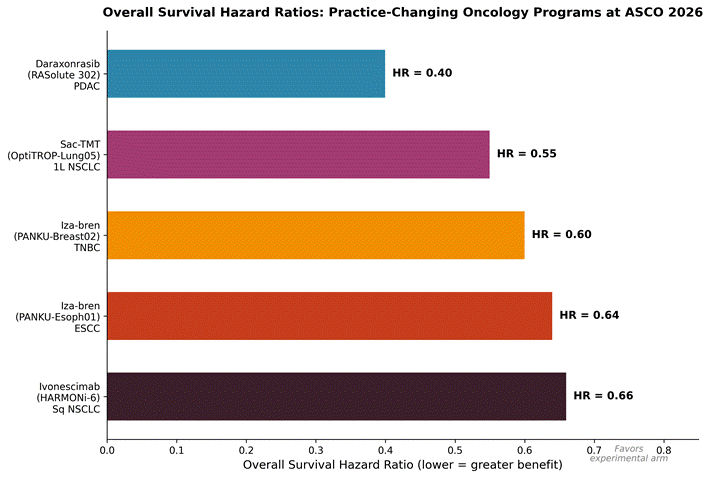
Overall Survival Hazard Ratios: Practice-Changing Oncology Programs at ASCO 2026
Chart Explanation: This figure compares overall survival hazard ratios across the major practice-changing oncology programs presented at ASCO 2026. All China-originated programs (ivonescimab, izalontamab brengitecan, sacituzumab tirumotecan) demonstrated clinically meaningful OS benefits with hazard ratios ranging from 0.55 to 0.66, benchmarked against daraxonrasib’s exceptional HR of 0.40 in pancreatic cancer.
The Australia+China Bundled Model.
For China-originated molecules seeking global out-licensing, a dual-geography early-phase strategy has emerged as the optimal pathway. Australia’s Clinical Trial Notification (CTN) pathway enables first-patient-in within two to three months of final protocol the TGA acknowledges the notification within two weeks without re-reviewing the protocol, with Human Research Ethics Committee approval serving as the primary regulatory gate. Companies additionally benefit from a 43.5% government rebate on eligible clinical trial costs. Running Phase I first-in-human studies in Australia in parallel with China Phase I/II programs creates a dual data package featuring ICH-compliant, Western-patient pharmacokinetic and safety data that de-risks global partnering negotiations and accelerates IND-enabling packages for FDA submission.
Emerald Clinical: The convergence of validated FDA registration pathways, multi-billion-dollar licensing deals, and the Australia+China bundled model creates a fundamentally new service requirement for CROs operating in the China-to-global space. CROs must now offer integrated capabilities spanning: early-phase execution across Australia and China with seamless data harmonization; registration-quality trial design incorporating FDA engagement strategies; multiregional expansion capabilities for pivotal studies; and regulatory affairs expertise bridging NMPA, TGA, and FDA requirements.
Strategic Implications: Redefining Emerald’s China Node
The evidence presented at ASCO 2025–2026 compels a fundamental reassessment of China’s role in global oncology development and, consequently, Emerald Clinical’s China value proposition.
Service Architecture Evolution. Emerald’s upgraded China offering should encompass three integrated tiers: the established PoC and speed advantages for early-phase programs; the Australia+China bundled Phase I/II pathway generating Western-standard data for out-licensing; and a new registration pathway tier providing end-to-end support from pivotal trial design through BLA submission, leveraging the regulatory lessons of the sintilimab-to-ivonescimab evolution. This three-tier architecture positions Emerald to serve China-originated programs at every stage of their global development journey, from initial proof-of-concept through FDA approval.
Conclusion
ASCO 2026 represents an inflection point in global oncology development. The ivonescimab HARMONi-6 plenary — delivering a 34% reduction in death risk with simultaneous Lancet publication and FDA BLA acceptance, is not merely a single drug milestone but a validation of an entire development paradigm. When combined with izalontamab brengitecan’s dual Phase III successes, sacituzumab tirumotecan’s remarkable first-line NSCLC data, and the proof-of-concept signals from next-generation bispecifics like IBI363, the evidence is unequivocal: China has transitioned from a geography of convenience to a geography of registration-quality innovation.
The regulatory pathway ivonescimab’s BLA acceptance provides a clear roadmap first-in-class mechanisms, unmet medical need, proactive FDA engagement, and multiregional design where appropriate.